
- by Todd Benadum
- June 22, 2026
- Dry Type Transformers, Uncategorized
A medium voltage transformer failure at a hospital, manufacturing plant or university is much more than a simple equipment problem — it’s an operational crisis. Manufacturing facilities can lose between $500,000 and $5 million per hour during unplanned outages, and that figure does not include emergency procurement costs, missed production deadlines or overtime for repair crews. For facility engineers and maintenance teams responsible for managing medium voltage dry type or oil-filled padmount units, transformer failure prevention begins with understanding their root causes.
What Drives Medium Voltage Transformer Reliability
Three primary categories determine a transformer’s long-term performance — how it was built, how it is operated and how it is maintained. With proper design and maintenance, a high-quality medium voltage transformer can deliver reliable service for decades.
Design and Manufacturing Quality
While the Institute of Electrical and Electronics Engineers, National Electrical Manufacturers Association and Department of Energy standards provide a solid foundation for manufacturing, true long-term reliability requires going beyond those minimum benchmarks. Investing in equipment that exceeds these standards helps achieve maximum transformer lifespans, rather than settling for a unit that only complies with industry regulations.
Operating Environment and Load Management
Environmental factors and improper load management are significant threats to dry type and padmount transformer durability. Blocked ventilation, corrosive atmospheres, high ambient temperatures, moisture infiltration and chronic overloading can all compromise transformer reliability. Proper load management means operating the transformer consistently within its kilovolt-ampere (kVA) rating and avoiding frequent, stressful current spikes.
Transformer Maintenance Best Practices
Proactive maintenance is the most cost-effective investment a facility can make to maximize transformer uptime and reliability. Before any maintenance begins, qualified personnel must follow the lockout/tagout procedures as mandated by the Occupational Safety and Health Administration to ensure the transformer is fully de-energized and isolated from all power sources.
Appropriate electrical personal protective equipment (PPE) — including voltage-rated gloves and arc-flash protection — must be worn throughout the process as an added layer of safety if a residual charge remains in the system. Respiratory and eye protection should also be worn when using vacuum equipment or compressed air.
General best practices for transformer maintenance include:
- Clearing dust and debris from cooling vents: Accumulated particulates restrict airflow and reduce heat dissipation.
- Checking fan motors on dry type transformers for proper operation: Fan failure eliminates forced cooling and can cause rapid overheating.
- Inspecting cooling fins and radiators on padmount transformers: Damaged or obstructed surfaces reduce heat transfer efficiency.
- Verifying proper ventilation clearances: Adequate airflow space prevents heat buildup and allows cooling systems to function properly.
Diagnostic Testing for Transformer Health
In addition to basic maintenance, an effective health program uses a range of diagnostic tests to identify internal issues before they escalate into catastrophic failures. These evaluations provide data on winding integrity, insulation health and related properties, allowing facility managers to make informed decisions regarding repairs or replacements.
- Transformer turns ratio testing: Verifies the voltage ratio between windings against specifications for dry type and oil-filled padmount units.
- Dielectric absorption testing: Evaluates insulation integrity to identify degradation, specifically for dry type transformers.
- Dissolved gas analysis: Detects gases produced by internal arcing or overheating, applicable only to padmount transformers.
- Load testing: Confirms the system’s ability to handle rated capacity under real conditions, especially after a repair, retrofit or load change.
All diagnostics should be performed by a qualified electrical testing company or certified professional using proper equipment and appropriate PPE.
Issues That Affect Dry Type and Padmount Transformer Performance
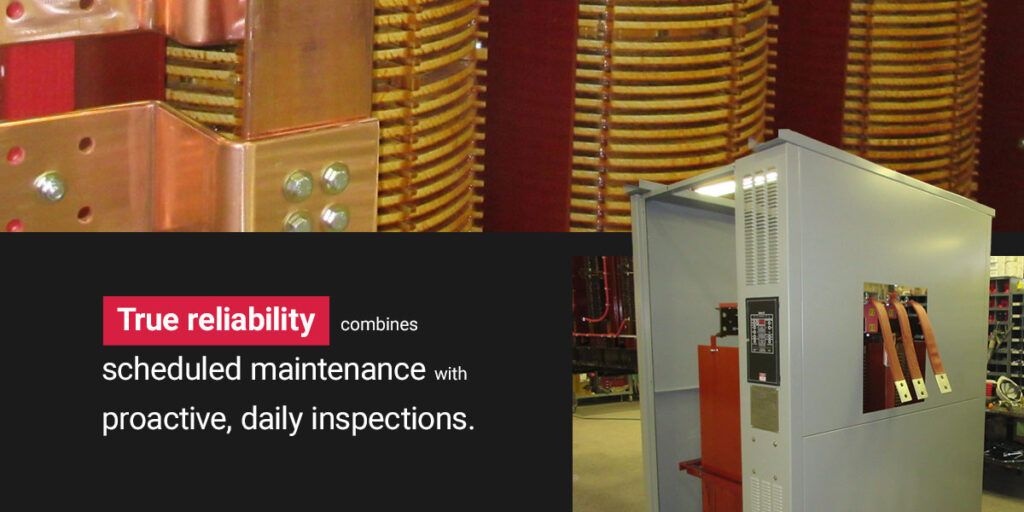
True reliability combines scheduled maintenance with proactive, daily inspections. Routine daily and weekly walk-throughs often reveal early indicators of failure that occur between service cycles. Recognizing these physical irregularities allows for a planned response rather than a quick reaction during a failure.
Warning Signs During Visual Inspection
Some of the indicators to look out for during visual inspections include:
- Odors: Note any burning smells or ozone, which indicate insulation off-gassing.
- Discoloration: Watch for darkened windings or insulation that suggests chronic overheating.
- Corrosion: Look for moisture-driven oxidation on terminals and critical connections.
- Fluid leaks: Document any oil seepage around padmount cabinets or bushings.
- Unusual sounds: Recognize buzzing or arcing that disrupts the standard transformer hum.
Using Advanced Monitoring Technology
Smart temperature sensors placed near hot spots provide continuous readings and automatically trigger cooling fans when needed. Supervisory Control and Data Acquisition integration enables maintenance teams to track trends and receive alerts remotely. Protection relays can automatically shut down a transformer or activate alarms when temperatures exceed safe operating limits.
The Repair, Retrofit or Replace Decision
The transformer repair vs. replacement decision is one of the most critical choices a facility manager faces, especially when lead times for new units stretch beyond a year. Understanding alternative options such as retrofitting and custom bus work can help prevent a facility from being shut down for extended periods.
Transformer Retrofits for Reliability
When a system fails, and the existing electrical infrastructure is healthy, a transformer retrofit may be the most efficient choice. This process adapts a stocked unit to match your original cabinet dimensions and footprint exactly. By using custom bus work to meet existing high and low voltage terminations, you avoid the labor and cost of rerouting cables or moving conduits.
This approach provides a compatible, plug-and-play solution quickly, rather than waiting months for a factory build.
When Full Replacement Is the Best Solution
Full replacement is usually necessary when a transformer can no longer meet the facility’s technical or operational requirements. A catastrophic winding failure often makes a repair technically impossible or financially unsound. Similarly, if a facility expansion requires a higher kVA rating, you should replace the old unit to handle the new load.
If a transformer has a history of recurring issues or is nearing the end of its service life, investing in new equipment is more cost-effective than continued maintenance or repairs. In these cases, the total cost of ownership favors a new unit because it eliminates the downtime risks associated with an aging or compromised system.
Improve Transformer Reliability With ELSCO
At ELSCO Transformers, our goal is to supply you with the most practical and effective solutions, backed by world-class support and comprehensive warranties. For over a century, our experience has driven every material choice, every winding specification and every unit we build.
We hand-assemble every dry type transformer using 100% copper windings and premium-grade insulation. Our commitment to superior quality is why we can offer an industry-best five-year warranty and why our new dry type systems have had zero failures due to manufacturing, design or materials since 1988. Many of our new units deliver reliable service for well beyond 35 years.
For outdoor applications, we engineer our oil-filled padmount transformers for cost-efficiency and exceptional long-term reliability. For facilities that need a stock unit modified to fit existing infrastructure, both padmount and dry type emergency replacements can often leave our facility within 24 to 48 hours. Additionally, ELSCO also designs and builds custom transformers for more complex operating requirements.