

- by Todd Benadum
- July 17, 2026
- Transformer Services
Critical facilities like hospitals, data centers and large industrial manufacturers depend on high-quality transformers to keep essential systems online and equipment running without interruption. An unplanned failure at any of these operations can cost hundreds of thousands of dollars per hour in lost production and emergency response costs. Many of those failures trace back to inadequate testing and maintenance.
Protecting your investment starts with understanding the testing and compliance requirements that help control how transformers perform over time. Knowing which tests apply to your equipment and what a structured maintenance program requires is essential for any decision-maker responsible for keeping critical infrastructure running smoothly and efficiently.
The Role of Maintenance and Visual Inspections in Transformer Reliability
Routine maintenance and visual inspections are your first line of defense against problems before formal testing begins. When left unaddressed, issues like loose connections, corrosion and cooling system problems can significantly shorten a transformer’s service life. A consistent inspection routine can add years to your equipment’s life.
Cooling system checks are among the most critical parts of an inspection routine. Dry type transformers require regular clearing of dust and debris from cooling vents and verification that fan motors are functioning correctly. Heat that cannot dissipate properly creates hot spots that damage windings over time.
Oil-filled padmount transformers require regular checks of cooling fins and radiators to ensure proper fluid circulation. Restricted flow causes heat to build up internally and accelerates insulation breakdown. While inspections address what is visible, internal faults and more complex issues require a more rigorous approach.
Overview of Transformer Standards
Transformer standards cover every stage of a unit’s life cycle, from its manufacturing and certification to its testing and field maintenance. Several standards organizations define those critical infrastructure transformer requirements, including the Institute of Electrical and Electronics Engineers (IEEE), the National Electrical Manufacturers Association (NEMA), the U.S. Department of Energy (DOE) and ASTM International. Understanding which standards apply to your equipment is a baseline requirement for compliance and a useful benchmark when evaluating suppliers.
NEMA insulation class standards cover the thermal performance criteria for dry type transformer manufacturing in the United States. These standards determine how much load a unit can handle and under what conditions. The farther a system operates beyond those limits, the more rapidly damage accumulates.
The DOE sets efficiency requirements for medium voltage transformers, requiring manufacturers to certify compliance through standardized testing procedures. Those procedures measure energy use, efficiency and estimated annual operating cost by transformer type. Meeting those requirements is a baseline for any medium voltage transformer supplier.
ASTM D3612 covers the analytical test method for measuring dissolved gases in oil-filled systems, while IEEE C57.104 provides a framework for interpreting results and identifying abnormal gas concentrations indicative of specific fault types. Together, these standards give facility managers a reliable method for identifying internal faults before they become failures.
Medium Voltage Transformer Testing for Critical Infrastructure
Standards define what transformers must meet. Testing is how you verify a unit is performing to those specifications. The right tests depend on the type of equipment in your facility.
Dry Type Transformers
Dry type transformer testing typically involves two types of procedures:
- Transformer turns ratio (TTR): Assess electrical integrity by verifying that the voltage ratio between windings matches design specifications. A significant deviation can indicate winding damage or a fault in the tap changer. Because TTR testing requires specialized equipment, it should be performed by a certified electrical testing professional with the appropriate personal protective equipment (PPE).
- Dielectric absorption tests (DAT): Evaluate insulation condition by measuring how well the insulation resists current over time. Insulation that cannot resist current properly will eventually fail, causing the transformer to short-circuit and go offline. DAT results establish a baseline that helps identify degradation trends before they become serious problems.
Padmount Transformers
Oil-filled padmount transformers are tested differently from dry types. Dissolved gas analysis (DGA) is a diagnostic tool unique to oil-filled designs. IEEE C57.104 provides guidelines for interpreting DGA results and identifying abnormal gas concentrations that indicate specific fault types, including:
- Overheating
- Arcing and sparking
- Partial discharge
- Mechanical stress
- Insulation degradation
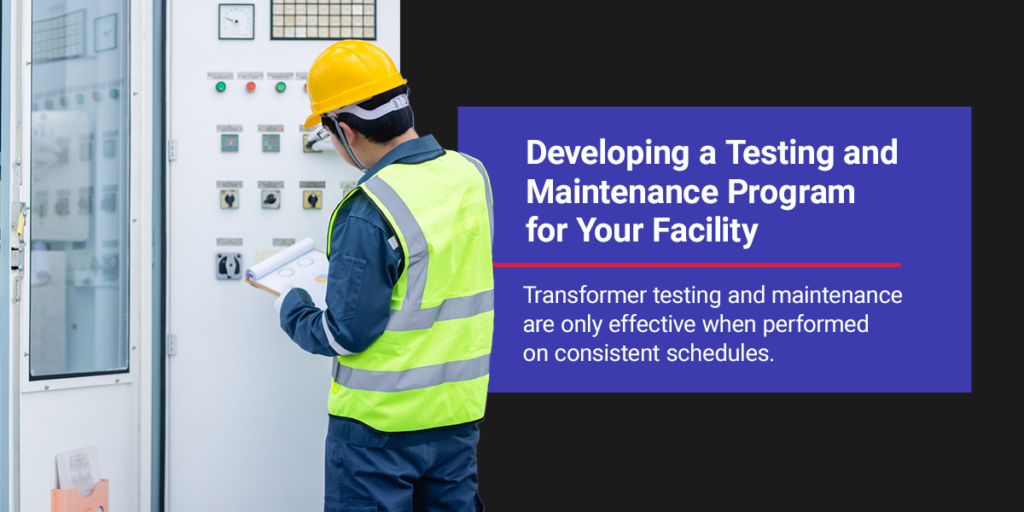
Developing a Testing and Maintenance Program for Your Facility
Transformer testing and maintenance are only effective when performed on consistent schedules. Testing should be planned during commissioning of a new or replacement unit and after an abnormal event, such as a fault or a significant load change. Additionally, scheduling a test before the warranty lapses allows you to address any issues while coverage is still in effect.
Safety Protocols
Following the proper safety protocols before starting any maintenance or inspection work is paramount. Requirements include:
- Following OSHA lockout/tagout (LOTO) procedures to eliminate the risk of accidental re-energization.
- Wearing appropriate electrical PPE as protection against stored energy that may remain in the transformer after de-energization.
- Using respiratory and eye protection when working with compressed air or vacuum equipment near cooling vents and enclosures.
- Outsourcing high-voltage electrical testing to a certified and qualified testing company with the proper equipment and credentials.
Warning Signs to Monitor
Catching early warning signs between scheduled maintenance and testing intervals can prevent minor issues from developing into major failures down the road. Common indicators include:
- Unusual odors that indicate internal burning or overheating.
- Visible corrosion on enclosures and hardware.
- Unexplained heat around connection points.
- Any odd noises, loud humming or changes in operating sound.
Working with a reputable and experienced transformer provider gives your facility access to the technical guidance needed to build a maintenance program around your specific equipment and operational demands.
How ELSCO Transformers Can Help
ELSCO Transformers has been engineering, repairing, building and selling transformers for over a century. Our team brings decades of combined hands-on experience and personalized service to every customer interaction. We work with customers across a wide range of industries to develop testing and maintenance programs tailored to their specific equipment and infrastructure.
Our dry type transformers have experienced zero product failures due to workmanship, quality, design or materials since we began building them in 1988. We handcraft every unit with copper winding and other premium-grade materials at our Cincinnati facility to meet or exceed transformer compliance standards. New indoor dry type transformers come with an industry-leading five-year warranty.
We also offer a complete lineup of services to handle all your transformer needs. Our custom bus work and retrofit services modify in-stock models to fit your existing setup, minimizing lead times and getting your facility back online faster. When you need a quick replacement, stocked dry type and padmount units can leave our facility within 24 to 48 hours of an order, depending on the needed modifications.
Contact the Professionals at ELSCO Today
Understanding transformer testing standards and building a structured maintenance program are essential steps for maximizing your operational efficiency and protecting your critical infrastructure from costly unplanned failures. ELSCO has the experience, the services and the track record to help you get there. Call 800-232-9002 with questions, or contact us online to request a quote.