

- by Todd Benadum
- February 4, 2026
- Dry Type Transformers, Padmount Transformers, Transformer Build Process
Reliable power keeps facilities operational, protects critical equipment and ensures essential services remain uninterrupted. Transformers help maintain that stability by converting primary power to usable voltages that systems can safely utilize. When a unit fails, operations can come to a halt until a replacement transformer arrives.
The current lead time for a custom dry type transformer often exceeds 50 weeks. Ordering a customized replacement directly after a failure leaves businesses and organizations vulnerable to extended outages. Some transformer failures can cost several hundred thousand dollars per hour, resulting in financial consequences that worsen by the day.
Forward-thinking facilities are shifting from reactive purchasing to strategic proactive planning. These approaches involve understanding the factors driving manufacturing lead times, exploring alternatives like retrofitting stock units to speed up delivery and choosing a reputable supplier that prioritizes your immediate needs.
Understanding Lead Times for Transformers
Material shortages drive most of the delay in transformer manufacturing. Grain-oriented electrical steel, which is essential for transformer cores, faces persistent supply constraints as global demand outpaces production capacity. High-grade copper for windings encounters similar challenges.
Manufacturing capacity remains limited as demand surges from grid modernization projects, data center expansions and renewable energy integrations. When multiple transformer manufacturers compete for the same limited materials, lead times across the industry lengthen. Unlike many electrical components, transformers can’t substitute alternative materials without compromising the magnetic and conductive properties that impact operational efficiency, heat management and overall lifespan.
While strategic procurement planning can’t eliminate these industry-wide material shortages, it reduces their impact on operations and project timelines.
Strategic Transformer Procurement Planning
Facilities that plan ahead maintain better control over timelines and costs. Aligning transformer purchases with long-term capital plans helps avoid the emergency replacement situation where extended lead times cause the most damage.
Forecast 12 to 18 Months Ahead When Possible
Start by assessing your existing transformer infrastructure. Document the age, condition and maintenance history of each unit. Older units showing signs of wear require closer monitoring and may need replacement planning.
Collaborate with facility managers to identify upcoming expansions, major equipment additions or transformers approaching replacement age. For campuses or facilities with multiple buildings or phased growth, order transformers in sequence based on actual need rather than waiting for failures to occur. Consider your supplier’s delivery times from the start, rather than waiting until contracts are signed and construction begins.
Even with careful replacement planning, it’s often highly beneficial to establish a backup transformer strategy to safeguard against unforeseen failures.
Build Relationships With Reliable Suppliers
Choose transformer suppliers based on responsiveness, capabilities and quality, not just price. Look for demonstrated expertise and personnel with decades of industry experience. The right supplier goes beyond simply taking orders. They maintain a ready stock, offer modification services and provide technical guidance that helps avoid unnecessary delays.
A supplier committed to solving problems rather than just selling products becomes invaluable when your operation faces extended downtime.
Alternatives to Long Lead Times
Facilities facing tight timelines have an alternative to waiting for custom builds. Purchasing in-stock transformers and modifying them to match specific requirements can significantly reduce delivery time without sacrificing quality.
Retrofitting In-Stock Transformers
Retrofitting modifies the connections while leaving core transformer components unchanged. Technicians adjust high-voltage cable connections and low-voltage bus work to match existing switchgear. Using the measurements, specs and photos you provide, suppliers make several key modifications:
- Bus work positioning: The orientation and placement adjust to match available clearances within the existing electrical room.
- Cable entry points: Entry locations align with the facility’s conduit runs and electrical routing to ensure proper connections.
- Voltage tap settings: Tap configurations meet the facility’s specific load characteristics and operational requirements.
- Physical mounting: Dimensions adapt to integrate seamlessly with floor plans and structural constraints at the installation site.
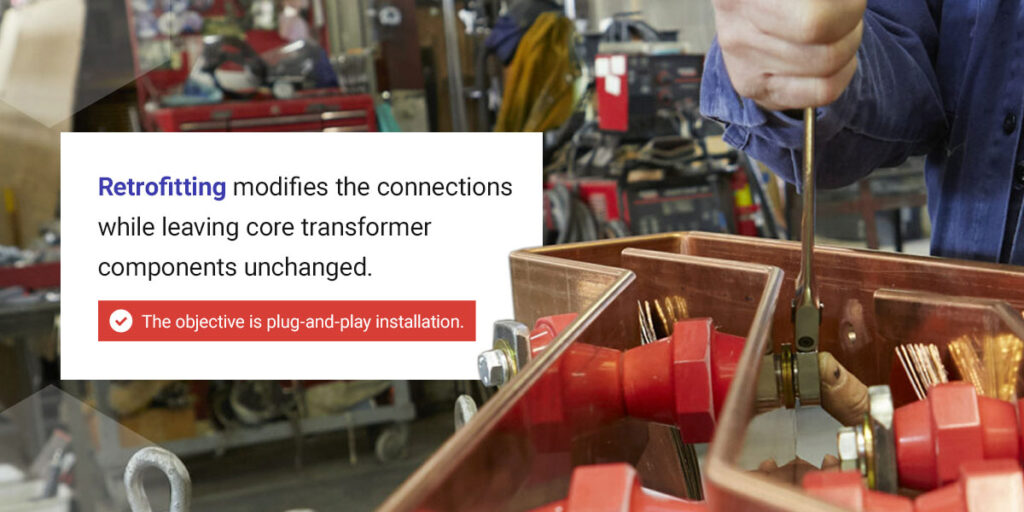
The process starts with your facility providing detailed measurements and photos of the existing setup. Technicians review clearance dimensions, cable entry locations and switchgear configuration against available stock units to identify the closest match. They determine which specific modifications will create a seamless fit, then begin adapting the bus work and connections accordingly.
The objective is plug-and-play installation. This capability ensures that when the modified transformer arrives at your facility, it plugs right into existing infrastructure without requiring changes to your electrical room or switchgear.
Hand-wound copper coils, magnetic circuits and insulation systems remain untouched. Only the external interfaces change to fit the installation. Rather than waiting for a custom build, facilities get proven transformer designs adapted to their specific setup.
Faster Delivery
Stock transformers that meet requirements without modification can often be shipped from the facility within days. While units requiring retrofit work take longer based on modification complexity, they still arrive far faster than custom builds. This approach works for planned projects on tight schedules and emergencies where extended downtime creates significant problems.
Maintaining Quality
Retrofitting does not compromise core transformer performance. The components that determine voltage transformation, efficiency and longevity are identical to custom-built units. Testing ensures each modified transformer meets specifications before shipping.
How ELSCO Transformers Can Help
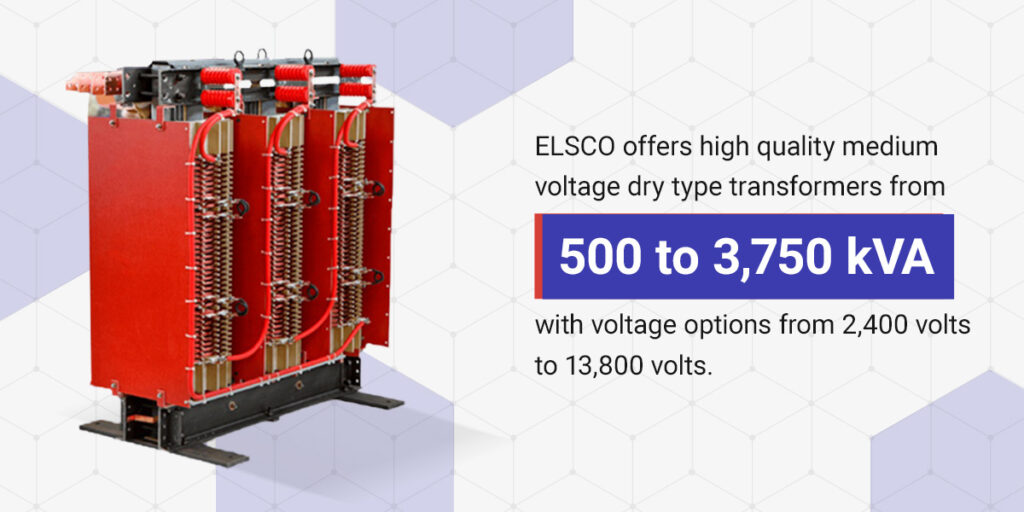
ELSCO addresses the lead time challenge through a combination of ready-to-ship stock units and in-house retrofit capabilities. ELSCO offers medium voltage dry type transformers from 500 to 3,750 kVA with voltage options from 2,400 volts to 13,800 volts. When modifications are needed, ELSCO technicians adapt high-voltage cable connections and low-voltage bus work based on measurements and photos you provide. Custom bus work integrates directly with your setup, eliminating installation complications.
Emergency Replacements
Unexpected transformer failures require immediate response. ELSCO’s emergency replacements provide 24/7 availability when critical equipment fails. Stock transformers that fit existing specifications leave the facility within 24 to 48 hours. When retrofit modifications are necessary to match switchgear and electrical infrastructure, work begins immediately to minimize facility downtime.
Partnering with us for your transformer needs means your operation can enjoy benefits like:
- Zero failures since 1988: No product failures on dry type transformers due to workmanship, quality, designs or materials since ELSCO began building them in 1988.
- Industry-leading warranties: Five-year coverage on new indoor dry type transformers compared to the standard one-year industry warranty.
- Hand-wound copper coils: Copper windings in dry type transformers deliver better performance and longevity than aluminum alternatives.
- Premium-grade insulation: DuPont Nomex insulation and SG200 fiberglass provide excellent efficiency, quiet operation and resistance to short circuits and excessive heating.
- Long service life: Dry type units deliver reliable service beyond 35 years due to material strength and build quality that minimize premature failure.
Contact The Professionals at ELSCO Today for More Information
Extended lead times don’t have to derail your projects or leave your facility vulnerable in the event of a failure. Partnering with ELSCO means having alternatives that can reduce lead times without sacrificing the quality you expect from your investment. We also provide repair services for existing transformers and customized units when schedules accommodate longer lead times.
Contact us online for a quote or call 800-232-9002 today to request more information about our capabilities.