

- by Todd Benadum
- February 18, 2026
- Dry Type Transformers, Transformer Retrofits, Transformer Services
Every facility has a unique electrical setup. Even sites that use the same transformer model have different connection configurations, mounting arrangements and bus work. When your transformer fails or you need an upgrade, waiting months for a custom-built replacement could cost you thousands in downtime.
Transformer retrofits offer a faster solution. These modifications involve adapting stock units to match your exact specifications, connection points and physical dimensions. This capability eliminates the long lead times of custom manufacturing while avoiding the expense of reworking your entire electrical infrastructure.
Understanding how retrofitting works helps you make faster, more cost-effective decisions when facing transformer replacement. This guide covers when retrofits make sense, technical specifications, custom bus work requirements and the complete retrofit process. Whether you’re dealing with an unexpected failure or planning a proactive upgrade, retrofitting may be your most practical option.
What Is a Transformer Retrofit?
A retrofit is when transformer suppliers modify in-stock dry type transformers based on manufacturing specs, measurements, detailed drawings and photos of your existing setup. Suppliers understand how to retrofit a transformer by adjusting high voltage cabling, low voltage bus bars, tap configurations and mounting arrangements to create a plug-and-play installation. This customization process ensures the replacement transformer fits your existing infrastructure perfectly.
How Retrofitting Saves Time
Retrofit units can cut weeks or months off your project timeline. Custom-built transformers must be engineered, manufactured and tested from the ground up. Retrofitting modifies transformers already in stock, eliminating most of the wait.
For emergency replacements, this time difference significantly reduces downtime and production losses. Retrofitted transformers integrate seamlessly with your existing infrastructure, avoiding the substantial cost and complexity of changing connection points or building new enclosures.
When You Might Need a Transformer Retrofit
Retrofitting provides a practical solution for old transformers nearing the end of their expected lifespan. Running an aging transformer until it fails often results in emergency downtime and production losses that exceed the planned replacement costs. When transformers operate beyond their temperature and insulation limits, damage accelerates rapidly — making timely replacement critical.
Transformer replacement becomes necessary when facing:
- Capacity increases from facility expansion: Transformers operating beyond rated capacity generate excessive heat that breaks down insulation.
- Natural disaster damage: Lightning strikes, flooding and other severe weather events cause damage that requires immediate replacement.
- Harmonics from modern electronic loads: Variable frequency drives and uninterruptible power supply (UPS) systems can stress older transformers designed for linear loads.
- Frequent maintenance problems: Breaker trips, overheating shutdowns, unusual noises or unfamiliar odors may indicate that the transformer is failing.
In these situations, retrofitting offers a faster alternative to custom manufacturing. Emergency failures especially benefit from retrofitting since finding the exact replacement parts for older models can significantly extend operational downtime.
Dry Type Retrofit Specifications and Options
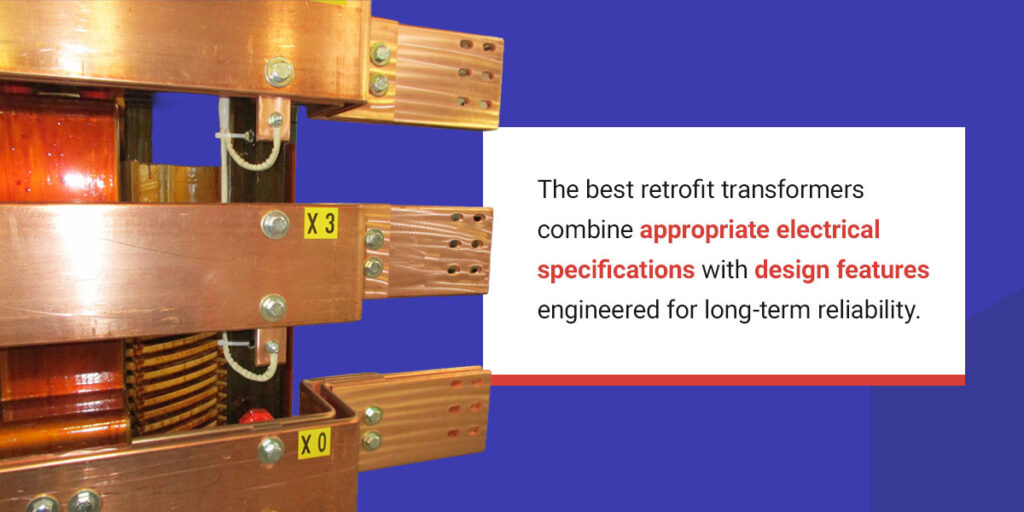
Retrofitting depends on finding a supplier with a compatible transformer in stock when you need it. Leading suppliers maintain an in-stock selection across multiple capacity and voltage configurations. The best retrofit transformers combine appropriate electrical specifications with design features engineered for long-term reliability.
Key Specifications to Evaluate
Retrofit transformers must align with your facility’s electrical requirements and physical constraints. Focus on specifications like:
- Capacity ratings (kVA): Determine how much load the transformer handles based on your facility’s current and projected power requirements. Undersizing causes overheating and premature failure, while oversizing wastes money on unnecessary capacity.
- Primary and secondary voltages: Ensure your utility voltage and equipment requirements align with the retrofit unit’s specifications. Dry type transformers convert high primary voltages to the correct voltage for your equipment.
- Tap configurations: Verify the number of taps available for voltage adjustment. Transformers with nine taps offer finer control for exact voltage requirements under varying load conditions than the standard five-tap configurations.
- Winding construction: Evaluate conductor materials for thermal performance. Efficient materials dissipate heat effectively under sustained loads, extending service life and reducing maintenance frequency.
- Insulation systems: Check insulation temperature ratings against industry standards. High-temperature materials withstand thermal stress better than standard options, extending operational life in indoor applications where dry type transformers typically operate.
Adhering to standards set by the National Electrical Manufacturers Association (NEMA) and Institute of Electrical and Electronics Engineers (IEEE) is crucial for ensuring retrofit transformers meet current efficiency, safety and performance benchmarks.
Availability and Lead Times
Retrofit capability depends on having the right transformer in stock when you need it. Leading suppliers offer a wide selection with multiple capacities and voltage configurations, allowing transformers to quickly leave the supplier’s facility, depending on the required modifications.
Reputable suppliers offer multiple solutions to minimize downtime. Pre-owned and refurbished transformers provide cost-effective options when available units match your specifications. For applications requiring specific voltage ratios or specialized features beyond standard configurations, some suppliers can engineer custom solutions, though lead times can exceed typical retrofit schedules.
Working with suppliers who maintain an extensive catalog and offer flexible solutions ensures you have options when your project timeline is critical.
The Importance of Custom Bus Work in Retrofitting
Retrofitting a transformer requires more than matching electrical specifications. Physical connections determine installation complexity and labor costs.
Connection points vary between transformer models. Without plug-and-play installation, electricians must fabricate new connections on-site to connect the replacement transformer to your existing electrical infrastructure.
Custom bus work solves this problem. Suppliers engineer high-voltage cables and low-voltage bus bars to match your existing connection points based on floor-to-bus measurements, breaker positions and motor control center locations.
The retrofitted transformer arrives ready to connect directly to your current infrastructure — no new enclosures, no structural modifications, no breaker panel rewiring. Electricians connect cables to predetermined positions rather than making on-the-fly modifications, reducing overall project costs and minimizing downtime during installation.
How Our Retrofitting Capabilities Can Help Your Operation
At ELSCO Transformers, our retrofitting process starts with understanding your current setup. We work with you to gather photos from multiple angles and critical measurements, including floor-to-bus heights, connection point distances and enclosure dimensions. Details about your existing electrical gear help us complete the technical picture.
We analyze which stock transformer best matches your requirements from our catalog of dry type transformers ranging from 500 to 3,750 kVA across multiple voltage configurations. Our engineering team then fabricates custom bus work, adjusts tap settings and reconfigures connections to align with your measurements. The modified transformer leaves our facility within 24 to 48 hours, depending on what modifications need to be made.
ELSCO manufactures copper-wound dry type transformers with nonflammable Nomex insulation and nine taps for precise voltage control. Our transformers meet Department of Energy efficiency standards while providing flexibility beyond typical five-tap configurations. We’ve experienced zero product failures on our dry type transformers since we started building them in 1988 due to workmanship, quality, design or materials.
Founded in 1912, ELSCO brings over a century of transformer experience to every retrofit project. Our team’s deep expertise in medium voltage transformers ensures your retrofit matches your existing infrastructure, minimizing downtime and installation complexity.
Discuss Your Retrofitting Requirements With ELSCO Transformers Today
If you want to find out more about how our retrofit units and other transformer services can benefit your operation, the experts at ELSCO can help. We’re excited to learn about your facility and recommend the most practical and effective solutions for your needs. Contact us online for a quote or call 800-232-9002 with questions.