
- by Todd Benadum
- November 25, 2025
- Dry Type Transformers, Padmount Transformers
Jump To:
- What Are the DOE Efficiency Standards?
- Benefits of Efficiency Standards to the Customer and the Industry
- How to Comply With Efficiency Standards
- Impacts of DOE Regulations and Compliant Transformers
- Transformers Exempt From DOE Efficiency Standards
- The Future of DOE Efficiency Standards
More than 40% of the energy used in the United States is consumed by building operations, including the electrical equipment and appliances within those buildings. While this equipment is essential to daily functionality in homes and business locations, ensuring that these appliances use energy efficiently is also gaining importance.
Since the Energy Policy and Conservation Act of 1975 was amended, the U.S. Department of Energy (DOE) has been responsible for ensuring that appliances meet a minimum standard of energy and water efficiency. The DOE rules apply to over 60 different product types used in public and commercial applications, including transformers.
Distribution transformers play a significant role in daily life, transforming the final voltage in an electric power distribution system. Transformers convert power into a form usable within buildings, making it essential for public, commercial and industrial applications. Since 2007, the Department of Energy has played a role in regulating the efficiency of transformers, and they’ve regularly updated their standards every several years.
While updates back in 2016 served as the previous benchmark, the DOE finalized a new set of energy-efficiency requirements for distribution transformers with a rule published in April 2024. These updated standards will go into full effect in 2029, providing a five-year transition period for manufacturers and the industry.
What Are the DOE Efficiency Standards?
The Department of Energy establishes energy-efficiency standards under the Appliance and Equipment Standards Program — a suite of programs under the Building Technologies Office (BTO). The Appliance and Equipment Standards Program helps reduce energy and resource consumption in buildings by maximizing the energy efficiency of appliances — including transformers.
More precisely, the DOE efficiency standards for transformers are codified in the Code of Federal Regulations (CFR), which aims to reduce the amount of energy and water required for equipment to operate. The standards have several different classifications, and each of those is further split according to whether they apply to single- or three-phase transformers.
While transformers have always been efficient, the latest DOE standards define the minimum efficiency levels transformer manufacturers must meet to improve the resilience and efficiency of America’s power grid, reduce energy bills and decrease domestic carbon dioxide (CO2) emissions. Because efficiency standards still need to be realistic, the DOE considers many factors when reviewing and developing the standards.
- Technical feasibility: The DOE takes into consideration recent technological changes and standards and what is feasible with these new innovations.
- Cost efficiency: While certain types of technology may be ideal for improving energy efficiency, not all options will be cost-effective for manufacturers or consumers. For this reason, the DOE takes current market costs into consideration when setting basic standards.
- Existing standards: The DOE often uses existing standards as a template for future regulations. This can include both federal and state standards, as many states choose to set their own requirements outside of federal mandates.
- Stakeholder input: The DOE takes input from a variety of stakeholders, including manufacturers, energy experts and consumer advocates. This input was crucial in establishing the five-year compliance timeline for the 2024 rule, demonstrating the DOE’s commitment to a realistic transition across the industry.
With the new standards finalized, manufacturers are responsible for complying with these regulations by April 2029.
Benefits of Efficiency Standards to the Customer and the Industry
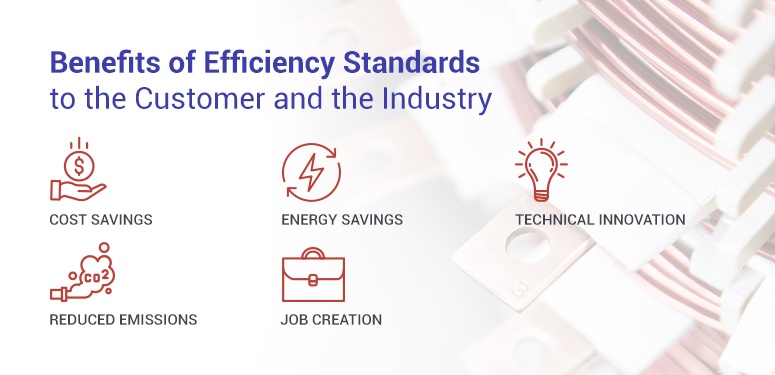
The benefits of DOE efficiency standards for transformers and other appliances are significant and widespread, positively affecting consumers and the industry at large. Below are some of the primary benefits of efficiency standards.
Cost Savings
DOE standards are designed to be cost-effective for consumers. Manufacturers are required to ensure that any increases in appliance and equipment prices will be recovered through electricity savings within the lifetime of the product.
The finalized 2024 standards are projected to generate significant energy savings, resulting in an estimated $14 billion in total energy bill savings for consumers over the next 30 years. These substantial savings underscore the long-term economic benefits of investing in higher-efficiency transformers.
Energy Savings
Energy-efficient appliances use less energy-intensive technologies, reducing the amount of electricity and water used in each product. This benefit is particularly important for transformers, as transformers work continuously. Over the next 30 years, improving transformer efficiency is expected to reduce energy needs significantly for households across America. Enhanced transformer efficiency also decreases energy waste and the demand for power grids.
Reduced Emissions
Energy-efficient appliances help reduce greenhouse gas emissions. By reducing electricity consumption, energy-efficient appliances require less energy generation from power plants, which often use fossil fuels. According to the DOE’s BTO, the standards implemented since 1987 have avoided 2.3 billion tons of CO2 emissions, equivalent to the annual emissions of 500 million cars.
In addition to CO2 reductions, improved transformer efficiency is also expected to significantly reduce emissions of other harmful pollutants such as nitrogen oxides, sulfur dioxide and mercury. The finalized 2024 standards are estimated to reduce CO2 emissions by 340 million metric tons over the coming decades, equivalent to the output of approximately 90 coal-fired power plants. This significant reduction in greenhouse gas emissions has a profound environmental impact and contributes directly to global sustainability goals.
Technical Innovation
Appliance and equipment standards ensure that manufacturers transition away from outdated technology more quickly, pushing them toward innovative and efficient product designs that can help the market as a whole. For instance, the 2024 standards mandate the use of amorphous steel in some advanced transformers, moving away from traditional, grain-oriented steel. The DOE prefers amorphous steel because it yields the lowest losses, making it a critical component for achieving the new efficiency targets.
Job Creation
While manufacturers are expected to lose up to 8.4% of their net value over the next 30 years, it is highly unlikely that manufacturers will see any plant closings or significant losses of employment. In fact, while standards can increase manufacturing costs, they create jobs in research, manufacturing and installation. The American Council for an Energy-Efficient Economy (ACEEE) estimates that 340,000 jobs were attributed to appliance standards in 2010 and that by 2030, this number could jump to 380,000 jobs in the United States.
How to Comply With DOE Transformer Efficiency Standards
The latest DOE guidelines for transformer efficiency expand on previous revisions. While the new regulations are consistent in scope, compliance methodology and exceptions with the DOE 2016 transformer standards, they introduce much higher required efficiency levels. The increase focuses on using higher-quality materials and advanced core technologies.
A key aspect of the new regulations is the requirement for certain designs to use amorphous steel cores, which are significantly more energy-efficient than traditional grain-oriented electrical steel cores. The results translate to more energy being conserved and reduced operational costs.
Complying with the DOE 2016 transformer efficiency standards is mandatory until the April 2029 deadline for the new 2024 regulations. After this date, any transformer shipped must conform to the latest, higher standards. The production, import and sale of noncompliant products will be prohibited.
While existing installed equipment is not required to meet these new standards, manufacturers will no longer be able to sell noncompliant products once the grace period has passed.
Compliance with current DOE standards is evaluated against the transformer efficiency formula that calculates the transformer’s efficiency by comparing the power used to the power supplied.
Impacts of DOE Regulations and Compliant Transformers
The latest Department of Energy efficiency standards have changed transformer designs and preferences in substantial ways. The most notable impacts are listed below:

- Transformer weight and dimensions: New standards have affected the overall weight and size of transformers. Overhead and three-phase transformers are particularly affected, with manufacturers adapting their designs to meet new efficiency requirements.
- Material costs: Efficient transformers require higher core material quality. Higher grades of conventional grain-oriented electrical steel and amorphous metals are particularly favored, with the former being the cheapest option. Both, however, are more expensive than materials allowed in previous standards, which has significantly increased production costs. The increased production costs are expected to be recovered in the long term as a result of higher efficiency and lower power consumption costs.
- Installation practices: Changes in size and weight for transformers have impacted the installation practices used for transformers. Pads for transformers have been redesigned to accommodate new dimensions, and transportation and handling practices have changed to account for the new weight and size.
Transformers Exempt From DOE Efficiency Standards
While the DOE efficiency standards apply to most distribution transformers, the standards don’t apply to the following types:
- Autotransformers
- Grounding transformers
- Regulating transformers
- Sealed transformers
- Testing transformers
- Welding transformers
- Rectifier transformers
- Nonventilated transformers
- Drive (isolation) transformers
- Machine-tool (control) transformers
- Special-impedance transformers
- Uninterruptible power supply transformers
- Transformers with a tap range of 20% or more
The Future of DOE Efficiency Standards
The future of DOE efficiency standards is now clearly defined by the April 2024 final rule, with full implementation set for April 2029. The overarching goal of the updated standards is to continue improving the power grid’s resilience, reducing consumer utility bills and lowering CO2 emissions. To facilitate this transition, the DOE, under the leadership of U.S. Secretary of Energy Jennifer M. Granholm and funded by President Biden’s Bipartisan Infrastructure Law, continues to develop and expand rebate programs.
These programs are designed to reduce the cost of replacing older distribution transformers for manufacturers, hospitals, utilities and other facilities. In addition, the government has invoked the Defense Production Act to proactively address potential supply chain challenges that could impact the manufacturing of critical electric grid components, ensuring a smoother transition to the latest standards.
Contact ELSCO Transformers for More Information
While the DOE efficiency standards for transformers are extensive, they pose significant benefits to consumers and the industry. As these requirements are now finalized and set for implementation, partnering with a manufacturer that can effectively navigate and comply with the new regulations is crucial. ELSCO Transformers is one such manufacturer.
If you need high-efficiency transformers that comply with DOE regulations, ELSCO can help. We are committed to providing quality products with comprehensive warranties and world-class support. Our experienced staff is ready to assist you with any questions regarding the updated standards and to help you find the most practical solutions for your needs.
Contact ELSCO today to learn more about our products or request a quote.